18 August 2026
Private vs Group Swimming Lessons: Which Is Better for My Child?
By Priya Nair, Swim Instructor · Last edited 18 August 2026
One of the first questions parents ask when enquiring about swimming lessons is:
"Should I choose private or group lessons?"
It's a reasonable question.
Many parents assume the answer is straightforward. Private lessons must be better because they're one-to-one. Or perhaps group lessons are better because children learn from one another.
After coaching children in both settings for years, I've come to a different conclusion.
Neither is inherently better.
The best lesson is the one that matches your child's personality, confidence and learning style.
A question I get almost every week
Not long ago, a parent called to enquire about lessons for her four-year-old daughter.
"I've heard private lessons are much better," she said. "Should I just sign her up for private lessons?"
Before answering, I asked a few questions.
Has she been in a pool before?
"Not really."
Is she excited about swimming?
"Actually… she's quite afraid of water."
Does she usually warm up quickly in new environments?
"No. She takes a while to get comfortable."
By the end of our conversation, my recommendation was clear.
Private lessons would probably give her the best start — not because private lessons are always better, but because they suited this particular child.
A week later, another parent contacted me.
His son couldn't wait to jump into the pool. He loved making new friends, enjoyed trying new activities and was already comfortable putting his face underwater.
This time, my recommendation was completely different.
A group class would likely suit him just as well.
Same coach. Same pool. Two very different children. Two different recommendations.
The question isn't "Which lesson is better?"
The better question is:
"Which environment helps my child learn best?"
Swimming isn't just about learning technique.
Especially for younger children, it's about confidence, trust and feeling safe enough to explore.
That's why personality often matters just as much as age.
When private lessons tend to work better
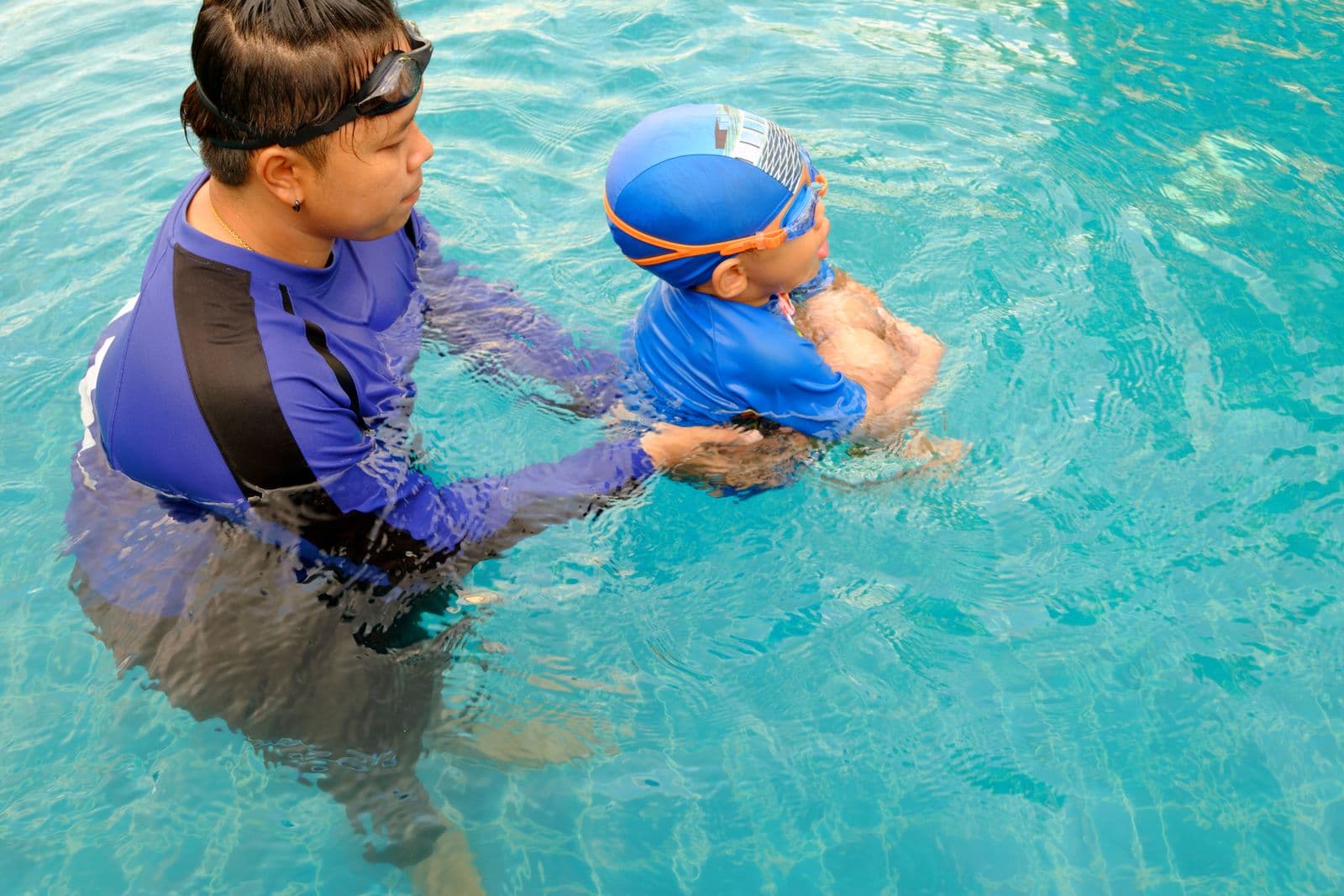
Private lessons allow the coach to adapt every minute of the lesson to one child.
There's no waiting for others. No need to match the pace of the group. Every activity can be adjusted immediately depending on how the child is responding.
Private lessons often work particularly well for children who:
- Are afraid of water
- Are very shy or take time to warm up
- Become distracted easily
- Need extra reassurance
- Have had a previous negative experience with water
- Learn at a pace that differs significantly from their peers
These children often benefit from having one familiar adult guiding them throughout the lesson.
Without the pressure of keeping up with other children, they're free to build confidence at their own pace.
When group lessons can be fantastic
Group lessons offer something that private lessons cannot.
Children learn from each other.
I've lost count of the number of times one hesitant child has suddenly tried something simply because another child did it first.
Peer influence can be incredibly powerful.
Group lessons also naturally develop:
- Patience
- Turn-taking
- Listening skills
- Social confidence
- Healthy encouragement between classmates
For children who enjoy being around others, the energy of a group can make lessons even more enjoyable.
Sometimes they don't even realise how much they're learning because they're too busy having fun.
The biggest misconception about private lessons
Many parents believe private lessons automatically mean faster progress.
Sometimes that's true. Sometimes it isn't.
A child who cries throughout a group lesson may indeed progress much faster in a private lesson.
But a confident, social child who enjoys learning alongside friends may progress just as quickly — or even faster — in a well-run group class.
The lesson format isn't the deciding factor.
The child is.
It's okay if your child needs private lessons first
One thing I often tell parents is that choosing private lessons doesn't have to be a permanent decision.
For some children, private lessons are simply the bridge that helps them become confident enough to eventually join a group.
Once they trust the water, understand basic instructions and feel comfortable around the pool, many transition into group lessons very successfully.
Others remain in private lessons because that's where they thrive.
Neither path is better. They're simply different.
So… which would I recommend?
If I had to make a recommendation without knowing your child, I couldn't do it honestly.
Instead, I'd ask questions. Things like:
- Is your child excited about swimming, or anxious?
- Do they enjoy learning alongside other children?
- Do they usually adapt quickly to new environments?
- Do they become distracted easily?
- Are they motivated by watching others?
- Do they need lots of individual reassurance?
Those answers tell me far more than your child's age.
A simple guide for parents
While every child is unique, here's a rough guide I often share with parents.
| Your child is… | Consider… | Why | | --- | --- | --- | | Afraid of water | Private lessons | More individual reassurance and a pace tailored to the child. | | Very shy | Private lessons | Time to build trust before introducing a group environment. | | Easily distracted | Private lessons | Fewer distractions and more focused learning. | | Comfortable in water | Group or private | Either can work well depending on learning style. | | Very social | Group lessons | Learns well alongside peers and enjoys interaction. | | Loves friendly competition | Group lessons | Often motivated by watching classmates improve. | | Preparing for SwimSafer | Depends on current ability | Some children benefit from individual refinement, while others gain confidence practising alongside peers. |
Notice that nowhere in this table does it say one option is always better.
That's because it isn't.
Don't choose the lesson. Choose the environment.
Looking back over the hundreds of children I've taught, the ones who progressed the most weren't always those in private lessons.
Nor were they always those in group lessons.
They were the children who felt comfortable enough to learn.
Some found that confidence through the individual attention of a private coach. Others found it by laughing alongside new friends every week.
Both are equally valid.
The best swimming lesson is the one your child looks forward to
As coaches, we naturally want children to develop good technique.
But before technique comes something even more important.
A child who enjoys coming to lessons.
Because children who look forward to getting into the water are more willing to try. More willing to make mistakes. More willing to keep going when something feels difficult.
Whether that's in a private lesson or a group lesson matters far less than many parents think.
So if you're deciding between the two, don't ask:
"Which one produces faster swimmers?"
Instead, ask:
"Which environment will help my child become the most confident learner?"
In my experience, when you get that answer right, the swimming usually takes care of itself.
Fill in the form and we can connect you with a suitable swimming coach who can assess your child's personality and recommend the right format for them.